Item Response Theory
Logistics
March 19-20, 2026 at the National Research Council of Italy (Consiglio Nazionale delle Ricerche (CNR)), hosted by TStat.
Materials
Overview
Item Response Theory (IRT) is a powerful framework for measuring latent constructs from categorical survey items. Unlike classical approaches such as summated scales or factor analysis, IRT models allow items to differ in their difficulty and discrimination, treat the categorical measurement level of items correctly, and yield individual-level estimates of the underlying latent trait. This short course provides a practical introduction to IRT using Stata, with a focus on applied social science research.
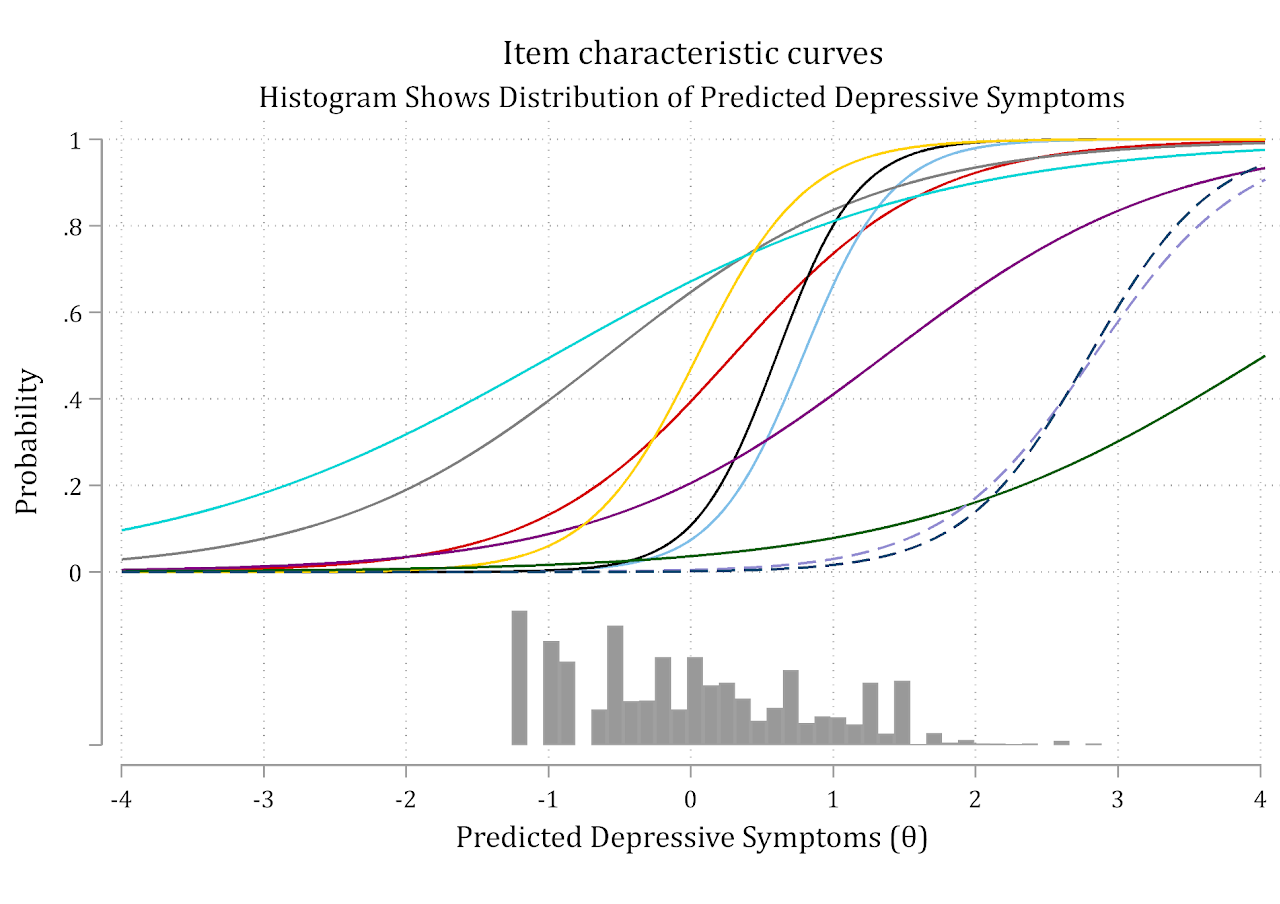
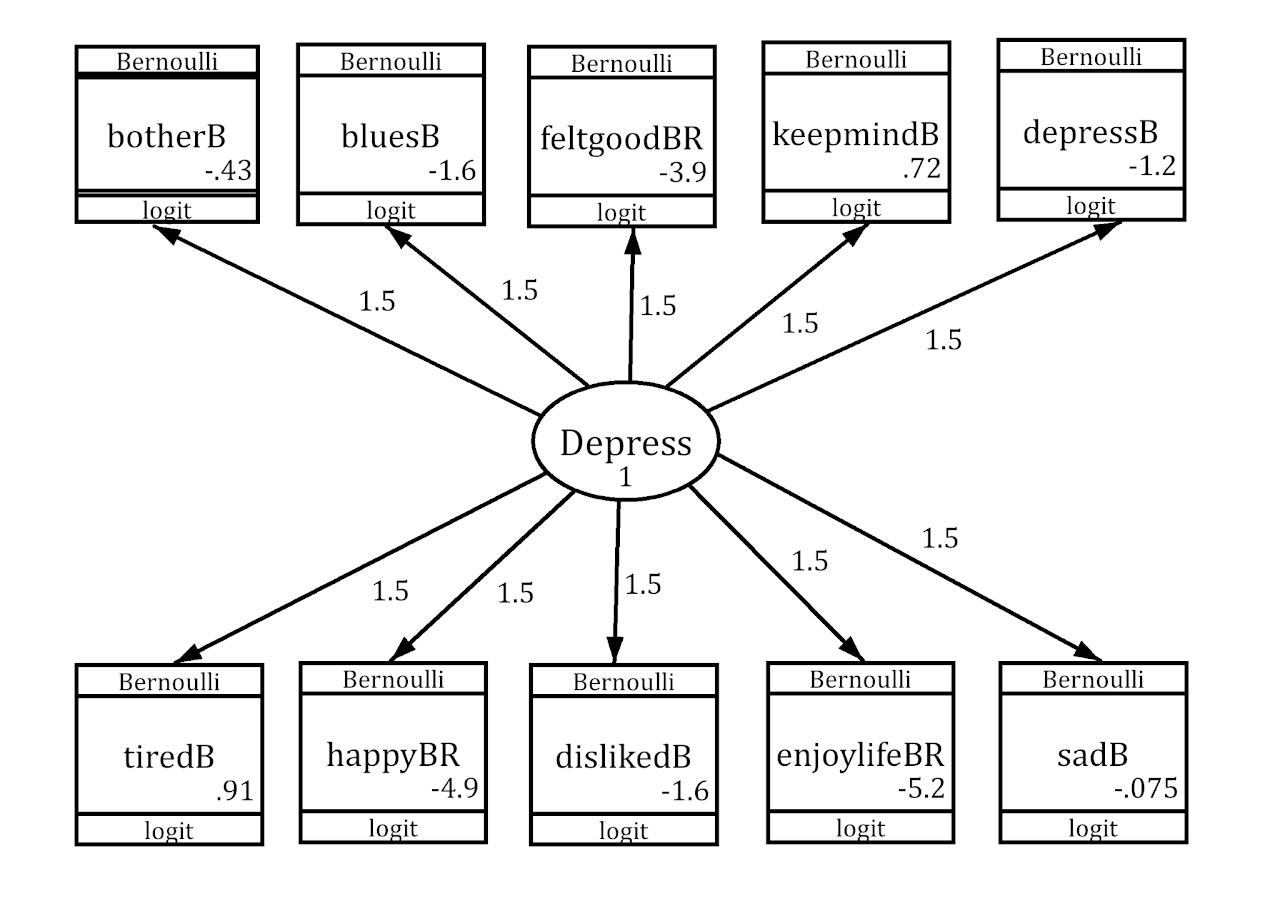
The course begins with foundational measurement concepts — including summated scales, exploratory factor analysis, and confirmatory factor analysis — before introducing IRT models for binary, ordinal, nominal, and count items — along with hybrid models. Emphasis throughout is on interpretation: item characteristic curves, marginal effects, and theta scores are used to make model results meaningful. The course concludes with structural equation modeling (SEM) extensions, showing how latent variables estimated via IRT can be incorporated as dependent or independent variables in SEM analyses, and introduces methods for assessing differential item functioning (DIF) and measurement invariance across groups.
All examples use Stata’s built-in irtand gsem commands, supplemented by the user-written irt_me and irt_coef commands.
Outline
Day 1
- Introduction to latent variable measurement
- Summated scales: logic, assumptions, and limitations
- Exploratory factor analysis (EFA): factor loadings, rotation, and factor scores
- Confirmatory factor analysis (CFA): testing measurement models in Stata
- Introduction to IRT: motivation, key concepts, and notation
- Polychoric and tetrachoric correlations for categorical items
- The 1-parameter (Rasch) IRT model for binary items
- The 2-parameter IRT model: discrimination and difficulty
- Model fit: likelihood ratio tests, AIC, and BIC
- Item characteristic curves (ICCs) and interpretation
Day 2
- Limits of IRT coefficients; marginal effects for IRT models
- The
irt_mecommand for automated marginal effect calculations - Accounting for measurement error; measurement factors
- The 3-parameter IRT model
- Estimation and missing data in IRT
- Ordinal IRT: the graded response model (GRM)
- y*-standardized coefficients with
irt_coef - Nominal IRT: the nominal response model (NRM)
- Comparing ordinal and nominal IRT results
- Count and hybrid IRT models
- Theta scores: prediction and use in subsequent analyses
- Structural equation modeling (SEM) with latent DVs and IVs
- Differential item functioning (DIF) and measurement invariance