3.7 Effect Summary Comparison
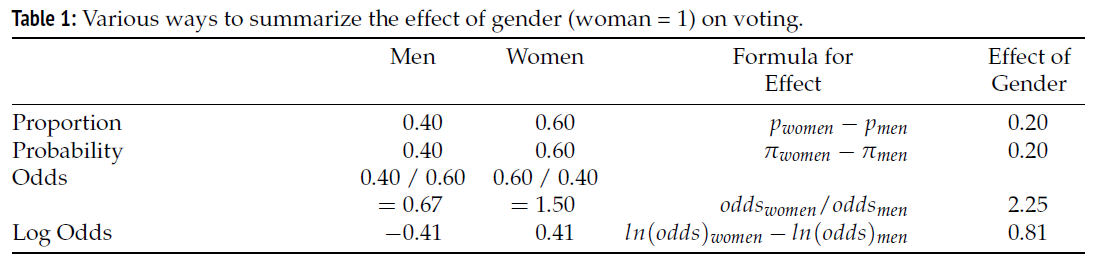
“Consider the various ways to summarize the hypothetical data in Table 1 on gender and voting. The dependent variable (voted in last election) is measured as a binary (voted = 1; did not vote = 0). When examining the effect of gender, the observed metric in the data are proportions: 40 percent of men voted; 60 percent of women voted. The probability that any given man in the sample voted is 0.40; the probability that any given woman in the sample voted is 0.60. Summarizing the effect of gender in the natural metric of the dependent variable would be calculating the differences in these two predicted probabilities (0.60 – 0.40 = 0.20).” (Mize 2019 p.83)
ORs and log-odds differences
“It is possible to convert the probabilities to odds (\(odds = \frac{\pi}{1 - \pi}\)), as row 3 of Table 1 does. Taking the ratio of women’s odds of voting to men’s odds of voting (\(OR = \frac{Odds_{women}}{Odds_{men}}\)) produces an odds ratio (OR): Women’s odds of voting are larger than men’s by a factor of 2.25. Further, we could take the natural log of men’s and women’s odds and then subtract the two, as the bottom row of Table 1 demonstrates. Indeed, the OR reported above is what you would obtain from exponentiating the coefficient from a binary logit model applied to these data regressing voting on gender (with the difference in log odds being the raw regression coefficient).” (Mize 2019 p.83)
- Which of these methods of summarizing the effect of gender on voting is most intuitive? Easiest to understand the effect size?
- The difference in probabilities, the ratio of odds, and the difference in log-odds all provide the same information; however, the interpretability differs greatly
- Marginal effects allow us to calculate effects as the difference in probabilities
- The marginal effect of gender = difference in probabilities (0.20)
- I find this by far the most straightforward, the one most connected to the data, and the one easiest to interpret
- The marginal effect of gender = difference in probabilities (0.20)