03 – Binary Regression Models
Categorical Data Analysis (Soc 681) · Purdue University · Fall 2026
The lecture notes for this section of the course, with the Stata and R code and output for every example. This site contains all the material and code for the course. If you prefer the slides in PDF format and/or the Stata replication do-file, these can be downloaded at: lecture slides · replication code.
Binary outcome models
- For all categorical DV models:
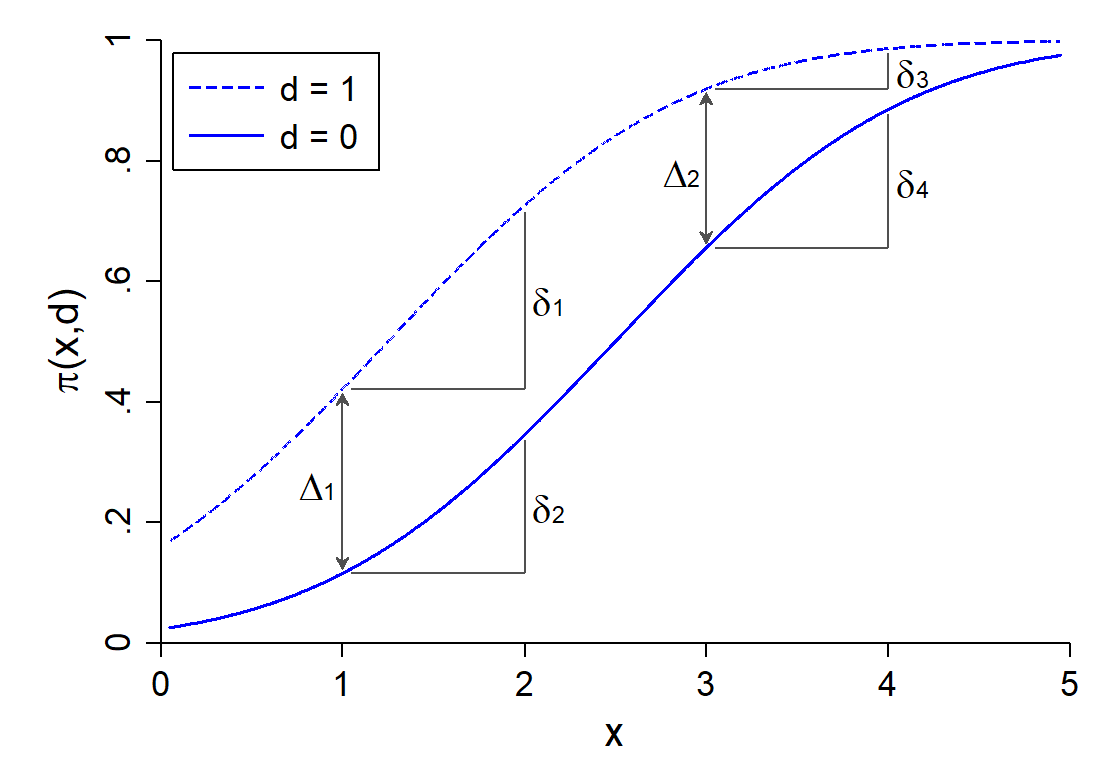
- Functional form is inherently nonlinear, even without polynomials
- All effects are interactive—meaning the effect of one variable can differ across various levels of other variables in the model, even without product terms
- The size of the coefficient often does not clearly represent the size of the effect
- Coefficients are not in the natural metric of the dependent variable
- Predictions must be transformed into the natural metric of the dependent variable for more useful interpretations
- Marginal effects can be calculated from predictions in the natural metric
Contents
- 3.0 Binary DVs and the Linear Probability Model
- 3.1 Binary Model Derivations
- 3.2 Scaling and Identification
- 3.3 Maximum Likelihood Estimation
- 3.4 Coefficient Interpretations
- 3.5 Interpreting Predictions
- 3.6 Marginal Effects
- 3.7 Effect Summary Comparison
- 3.8 Predictions for Ideal Types
- 3.9 Risk Ratios/Relative Risk (RR)
- 3.10 Bonus: Tables & Plots of Results
- 3.11 Miscellaneous & Conclusion
- Appendix 3A: Stata Code and Tips
- Appendix 3B: Maximum Likelihood
- Appendix 3C: OR and MEM Comparison
- Appendix 3D: Distribution of Marginal Effects
- Appendix 3E: Flexible Functional Forms
- Appendix 3F: Interpretation in y* Metric
- Appendix 3G: Marginal Odds Ratios