2.3 Linear Interaction Effects
“Interaction effects exist when the effect of one independent variable is contingent on the level of another independent variable. For example, does the effect of obtaining more education depend on whether someone is white or black? Does the effect of aging depend on whether someone is a man or a woman?” (Mize 2019 p.81)
- Interaction effects are also known as moderation (i.e., one IV moderates the effect of another IV)
- Can allow the effect of one IV to vary across levels of another IV by including a product term of the two variables in the model
- Multiply the two IVs together
- Include the two original IVs and the product term in the model
Interaction effect example and interpretation
use "https://tdmize.github.io/data/data/cda_gss", clear(cda_gss.dta | GSS 1972-2021 CDA - Categorical Data Analysis | date created 202
> 3)regress occprest c.age##i.woman i.college Source | SS df MS Number of obs = 58,304
-------------+---------------------------------- F(4, 58299) = 4703.09
Model | 2777942.63 4 694485.657 Prob > F = 0.0000
Residual | 8608766.27 58,299 147.665762 R-squared = 0.2440
-------------+---------------------------------- Adj R-squared = 0.2439
Total | 11386708.9 58,303 195.302281 Root MSE = 12.152
-------------------------------------------------------------------------------
occprest | Coefficient Std. err. t P>|t| [95% conf. interval]
--------------+----------------------------------------------------------------
age | 0.072 0.004 16.316 0.000 0.063 0.081
|
woman |
Women | 2.365 0.290 8.146 0.000 1.796 2.934
|
woman#c.age |
Women | -0.055 0.006 -9.343 0.000 -0.067 -0.044
|
college |
College De.. | 16.392 0.121 135.948 0.000 16.156 16.628
_cons | 35.226 0.216 162.811 0.000 34.802 35.650
-------------------------------------------------------------------------------est store opintmod
est table opintmod, ///
title("[2.3.a] Occupational prestige linear regression model" ///
"Interaction between age & gender") ///
b(%5.3f) star(.05 .01 .001)[2.3.a] Occupational prestige linear regression model Interaction between age &
gender
---------------------------
Variable | opintmod
-------------+-------------
age | 0.072***
|
woman |
Women | 2.365***
|
woman#c.age |
Women | -0.055***
|
college |
College D.. | 16.392***
_cons | 35.226***
---------------------------
Legend: * p<.05; ** p<.01; *** p<.001qui margins, at(age=(20(5)80) woman=(0 1))
marginsplot, ///
title("[2.3.b] Predicted Occupational Prestige Based on Person's Age and G
ender", size(medium)) ///
subtitle("Interaction Term: Gender X Age") ///
ytitle("Occupational Prestige") ///
recastci(rline) ciopts(lpat(dash) col(gs14)) ylab(38(2)46)Variables that uniquely identify margins: age woman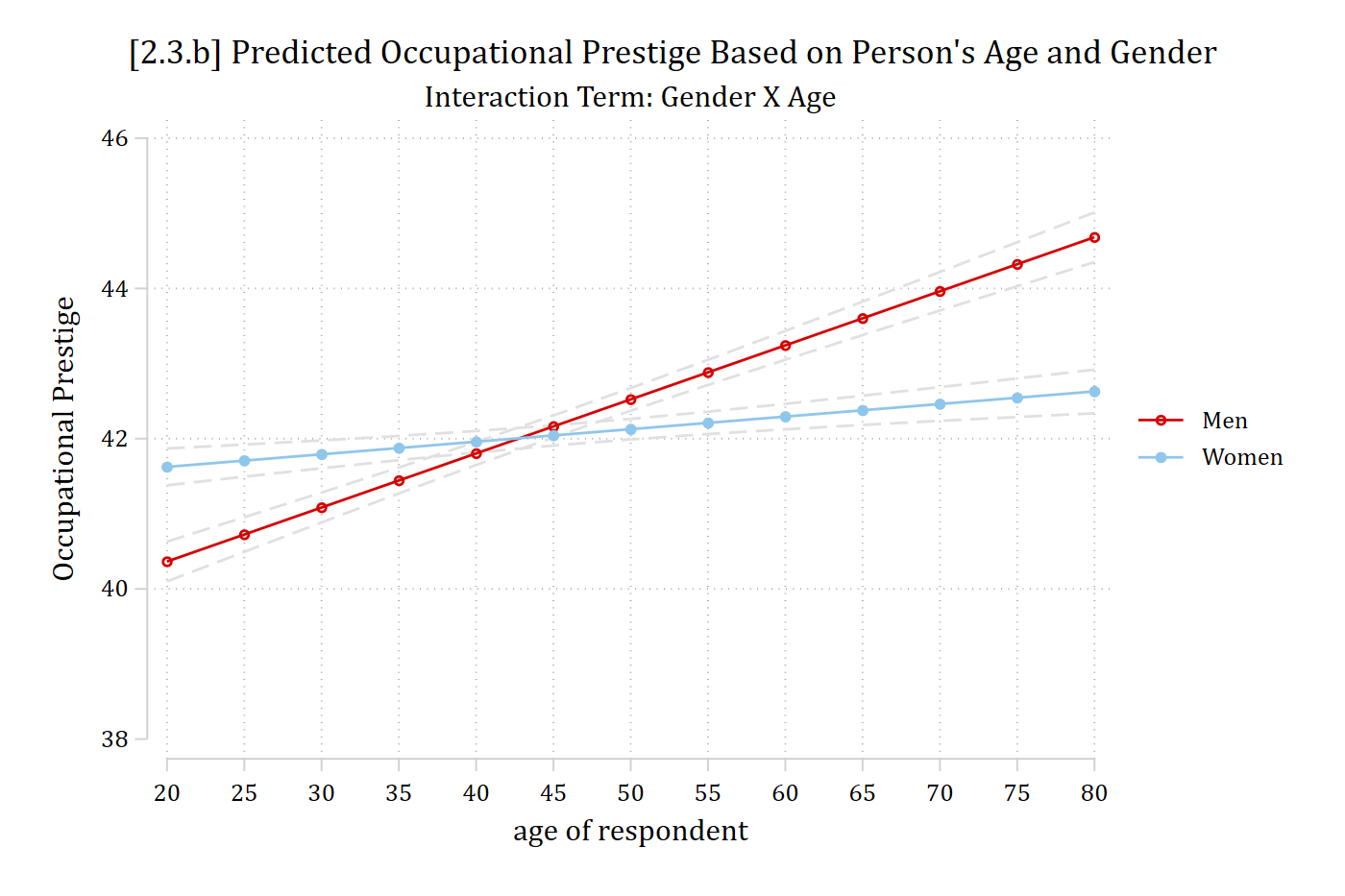
Marginal effects by levels of another variable
- With linear effects, we can calculate the slope for each level of the nominal variable (here, woman) by adding the coefficients
- But, the coefficients don’t provide a significance test for the effect of age for woman=1
- Marginal effects straightforwardly provide this, without the need for mental math
est restore opintmod(results opintmod are active now)mecompare age, by(woman)Predicting: Linear prediction
Marginal effects (N_m1=58304)
| ME # Estimate SE P>|z|
---------------------------------+---------------------------------------
age + 1 (centered) |
Men | 1 0.072 0.004 0.000
Women | 2 0.017 0.004 0.000- Easy to test the equality of the marginal effects; in the case of linear effects, will provide equivalent answer to interaction coefficients (but only in this case!)
metest 2 - 1 | estimate se pvalue
---------------------------------+--------------------------------
age_woman_1 - age_woman_0 | -0.055 0.006 0.000